
Proof, Not Promises: What Your RMM Can’t Show You About Your Apple Devices
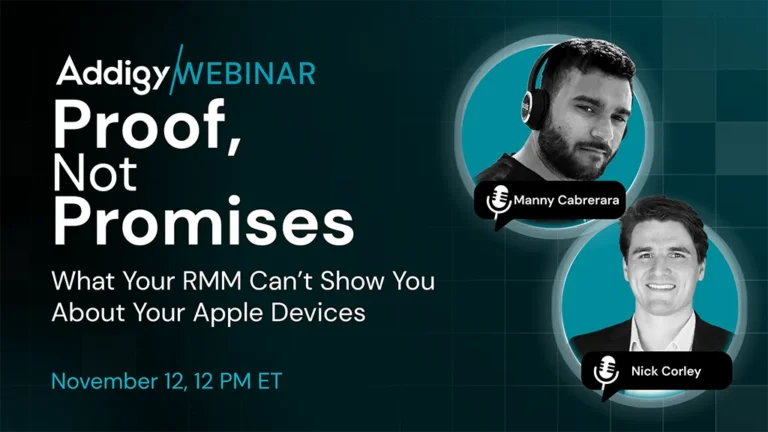
Your RMM says your Apple devices are managed. Can it prove it? When a client, an auditor, or your own team asks what happened on a device, a green checkmark is not an answer. Join an MSP engineer who inherited an unmanaged environment and an Addigy expert as they put RMM-based Apple management to the proof test.
Key Highlights
- The Four Proof Tests: Proof of encryption, proof of execution, proof of history, and proof of consistency. For each one, the question a client or auditor asks, what an RMM view typically gives you, and what proof looks like.
- Status Is Not Evidence: A dashboard status tells you a device checked in. It does not tell you the device is configured correctly.
- Live Demo: Policies and flex policies, FileVault from enforcement to key, full script output and event logs, security stack deployment with client-specific variables, and shared iPad management on iPadOS.
- Fireside with an MSP Practitioner: What he found when he took over an unmanaged environment, what he fixed first, and where his RMM still fits alongside Addigy.
Why Attend?
- Score Your Own Setup: Attendees score themselves 0 to 4 as the four proof tests run.
- See What Proof Looks Like: Watch a script run on a device, then open the full output and the event log. Could you reconstruct this from your RMM?
- Leave With a Plan: Run the Proof Test on your own setup this week. Pick one client, answer the four proof questions, and count where the answer is “I think so.” Those are your gaps.
Addigy works alongside an RMM. Use the RMM for what it does well and use Addigy where Apple devices need provable control.
Speakers:
Manny Cabrera Solutions Architect Manager, Addigy
Nick Corley, of Concept Technology Inc
Tier-3 Engineer at Concept Technology, Inc. specializing in Apple endpoint management with Addigy, enterprise cloud virtualization (AVD/Nerdio, Hyper-V), and secure network architecture. Highly focused on automation, and scalable structures.