
Simplify Compliance and Enhance Security with Addigy
TL;DR
For Apple-heavy environments, compliance can’t be a quarterly check-in. Modern frameworks assume continuous, real-time enforcement on every endpoint:
- Cover the frameworks that matter — CIS, NIST, HIPAA, SOC 2, plus CMMC, ISO, NIS2, and FFIEC
- Catch drift the moment it happens, not at the next sync
- Auto-remediate without manual sweeps
- Produce exportable, audit-ready evidence on demand
- Move from “we pushed a profile last month” to “we know our fleet is compliant right now”
The fix: an Apple-first MDM with continuous policy enforcement, real-time monitoring, and audit-ready reporting — so IT can prove compliance without manual policing.
In today’s digital landscape, businesses and organizations recognize the utmost importance of complying with industry standards, regulations, and security best practices. Achieving and maintaining compliance across a fleet of devices has been a time-consuming and challenging task for many IT administrators and Managed Service Providers (MSPs). However, Addigy, the leading Apple device management solution, has revolutionized the approach to compliance for organizations. Let’s explore how Addigy’s powerful features help simplify compliance and enhance security.
Compliance is no longer a quarterly box to check. Frameworks like CIS, NIST, HIPAA, SOC 2, and CMMC now assume continuous enforcement on every endpoint — not “we pushed a profile last month.” For IT teams managing Apple devices, that shift creates a real problem: most MDMs were built around periodic check-ins, leaving devices to drift between syncs while audit and cyber insurance pressure tightens. A device that was compliant at last check-in may be non-compliant — or compromised — ten minutes later. Addigy’s Apple-first compliance engine closes that gap with real-time enforcement, auto-remediation, and audit-ready evidence — so IT can move from guessing to knowing., and security best practices. Achieving and maintaining compliance across a fleet of devices has been a time-consuming and challenging task for many IT administrators and Managed Service Providers (MSPs). However, Addigy, the leading Apple device management solution, has revolutionized the approach to compliance for organizations. Let’s explore how Addigy’s powerful features help simplify compliance and enhance security.
What Triggers a Compliance-Driven MDM Evaluation
Most teams don’t go looking for a new compliance approach until something forces the conversation. Common triggers:
- An audit finding flags Apple devices as a gap
- Cyber insurance renewal requires evidence of continuous endpoint enforcement
- A new framework (HIPAA, SOC 2, CMMC, NIS2) enters scope after growth or acquisition
- EDR or vulnerability tools repeatedly flag the same Apple issues
- Manual spot-checks are eating IT’s bandwidth and still missing drift
If any of these resonate, the cost of staying with periodic-check-in tooling is already higher than the price of a purpose-built Apple compliance platform.
Addigy’s Powerful Apple Compliance Solutions:
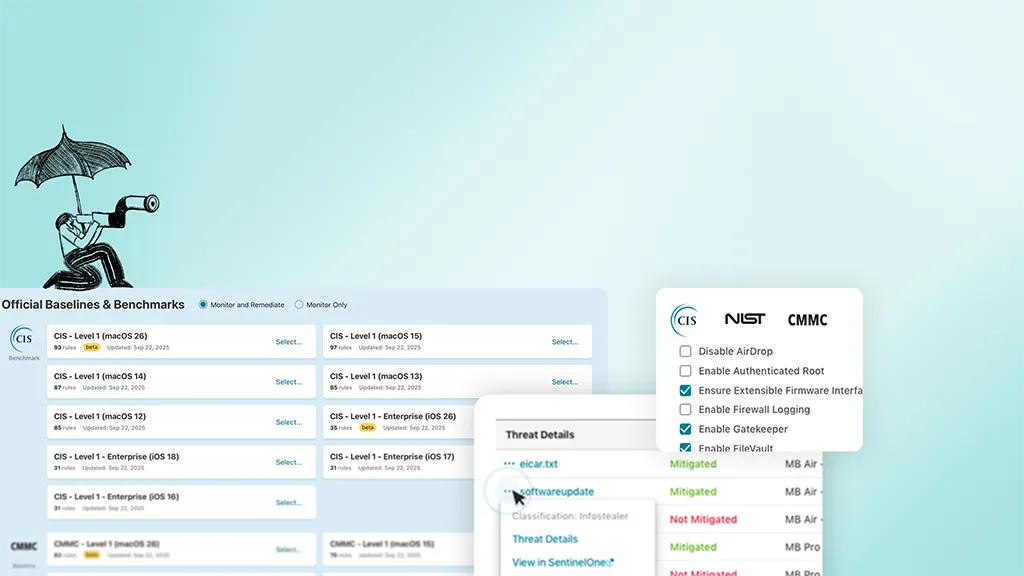
Simplifying Compliance Effortlessly: Addigy’s Compliance engine allows organizations to bring their devices up to CIS and NIST standards without manual intervention, saving time and minimizing security risks.
- Continuous compliance enforcement: Bring devices up to CIS Level 1, NIST, HIPAA, and SOC 2 — plus frameworks like CMMC, ISO, NIS2, and FFIEC — with real-time enforcement, not periodic check-ins.
- Convenient Monitoring and Enforcement: The platform offers IT administrators and MSPs the convenience of one-click monitoring and enforcement of benchmarks, enabling efficient compliance management.
- Auto-remediation without manual sweeps: When a device drifts out of compliance, Addigy detects and remediates the gap automatically — so IT spends less time policing endpoints and more time on strategic work.
- Customizable Benchmarks: Addigy provides pre-built benchmarks that can be easily customized to suit the unique requirements of each organization, ensuring flexibility in compliance implementation.
- Customizable, Apple-aware benchmarks: Pre-built benchmarks tuned specifically for macOS and iOS, easily customized for organization-specific controls or vertical-specific requirements (healthcare, finance, government).
- Comprehensive Reporting: Addigy offers comprehensive reporting capabilities, enabling IT administrators to track compliance down to individual benchmark rules and demonstrate compliance status to stakeholders.
- Audit-ready, exportable evidence: Track compliance state down to individual benchmark rules and produce evidence auditors and leadership can act on — without piecing together screenshots, scripts, or spreadsheets.
- Secure Conditional Access: With Addigy’s integration with Intune, organizations can implement conditional access policies to ensure secure access to corporate data.
- Conditional access tied to real-time compliance state: Integrate with your identity provider to enforce conditional access policies based on whether a device is currently compliant — not whether it was compliant at last sync.
- Empowering End-Users: Addigy empowers end-users with self-service access to their compliance status, enhancing user experience, user trust, and reducing administrative burden.
- Self-service for end users: Empower employees with visibility into their own device compliance status, reducing ticket volume and building trust without adding IT overhead.
Success for Your Organization
Through Addigy’s powerful solutions, organizations have experienced significant success in simplifying compliance and enhancing security:
- Streamlined Compliance Deployment: Addigy’s seamless compliance deployment has enabled organizations to bring their devices up to industry standards quickly and effortlessly, saving valuable time and focusing on core tasks and strategic initiatives.
- Enhanced Security Measures: Addigy’s one-click monitoring and enforcement of benchmarks have provided organizations with enhanced security measures, strengthening their defense against potential cyber threats.
- Flexibility and Customization: Addigy’s pre-built benchmark and customization options have offered organizations the flexibility to adapt compliance requirements to their unique needs, especially for businesses with specific security or regulatory considerations.
- Transparency and Reporting: Addigy’s comprehensive reporting capabilities have empowered IT administrators to gain a clear understanding of compliance status across their device fleet, facilitating better decision-making and streamlined communication with stakeholders.
- Secure Access to Corporate Data: Addigy’s integration with Intune and Self-Service have enabled organizations to implement secure conditional access policies for corporate data while building user trust, instilling confidence in end-users and maintaining data security.
Why Continuous Apple Compliance Matters in 2026
Four shifts have made continuous compliance the new baseline for Apple environments:
- Patch latency is now a board-level metric. How fast you move from “update available” to “update enforced” matters more than the absolute OS version you’re targeting — and it shows up in audit findings and cyber insurance questions.
- AI-era attacks move faster than periodic check-ins. Automated ransomware and AI-driven exploitation can compromise a device long before the next scheduled sync. Continuous enforcement closes that window.
- Compliance frameworks have caught up. CIS, NIST, HIPAA, SOC 2, CMMC, and NIS2 now assume continuous enforcement on endpoints. “We pushed a profile last month” no longer satisfies an auditor.
- Apple’s Declarative Device Management (DDM) makes it architecturally feasible. DDM lets devices enforce policy continuously on their own — but only if your MDM is built to take advantage of it.
- Addigy was built for this model from the start: real-time visibility, continuous enforcement, and DDM-ready architecture for Apple’s roadmap.
Addigy has revolutionized Apple device management, simplifying compliance and enhancing security for businesses and organizations. Embrace Addigy today and experience the power of seamless compliance and enhanced security for your Apple devices.
Ready to Move from Periodic to Continuous Apple Compliance?
Compliance shouldn’t be a quarterly fire drill or a manual evidence-gathering exercise. With Addigy, IT teams can enforce CIS, NIST, HIPAA, SOC 2, and other frameworks continuously across their entire Apple fleet — and produce audit-ready evidence on demand.
Learn more about Addigy’s Apple compliance platform — or request a personalized demo today.
Frequently Asked Questions
What does continuous compliance mean for Apple devices?
Continuous compliance means your MDM enforces policy in real time, every moment a device is online — rather than checking compliance only at periodic sync intervals (typically every few hours). With continuous compliance, drift is detected and remediated the moment it happens, and your fleet stays audit-ready without manual spot-checks.
Which compliance frameworks does Addigy support?
Addigy provides continuous policy enforcement against CIS Level 1, NIST, HIPAA, SOC 2, CMMC, ISO, NIS2, and FFIEC. The platform monitors compliance state in real time, auto-remediates drift, and produces exportable audit-ready evidence aligned to each framework’s control set.
What is Declarative Device Management (DDM)?
Declarative Device Management is Apple’s modern management model where devices continuously enforce policy on their own, rather than waiting for the next check-in from an MDM server. DDM reduces server load, improves responsiveness, and is required to take full advantage of newer macOS, iOS, and iPadOS features.
How does Addigy detect compliance drift?
Addigy maintains a persistent, live connection to every managed Apple device. When a setting changes, a security control is disabled, or a required configuration is removed, Addigy detects the drift immediately — not at the next scheduled check-in. Drift events trigger auto-remediation workflows or alerts based on the policies you’ve configured.
What is auto-remediation in Apple compliance?
Auto-remediation is the practice of automatically restoring a device to a compliant state when drift is detected, without manual IT intervention. For example, if a user disables FileVault encryption or an antivirus agent stops running, Addigy detects the change and re-enables the required control automatically — closing the security gap in seconds rather than waiting for a help desk ticket.
How does Addigy provide audit-ready evidence?
Addigy tracks compliance state down to individual benchmark rules and produces exportable reports aligned to frameworks like CIS, NIST, HIPAA, and SOC 2. IT teams can demonstrate compliance posture to auditors, leadership, or cyber insurance providers without piecing together screenshots, scripts, or manual spreadsheets.
Can I customize CIS Level 1 benchmarks for my organization?
Yes. Addigy provides pre-built benchmarks aligned to CIS Level 1 and other frameworks, all of which can be customized to fit organization-specific controls or vertical-specific requirements. Healthcare organizations can layer in HIPAA-specific controls, financial services teams can add FFIEC requirements, and government contractors can tune for CMMC.
How does Addigy support conditional access?
Addigy integrates with identity providers to enforce conditional access policies based on a device’s real-time compliance state — not its compliance state at last sync. This means access to corporate resources is granted or revoked based on whether the device meets policy right now, closing the gap that periodic-check-in MDMs leave open.
What’s the difference between periodic and continuous compliance enforcement?
Periodic enforcement checks devices on a fixed schedule — every few hours, every day, or at user login. Between checks, devices can drift out of compliance without IT knowing. Continuous enforcement maintains a live connection and enforces policy in real time, so non-compliant states are detected and corrected immediately. For modern frameworks like CIS, NIST, and SOC 2, continuous enforcement is now the expected baseline.
How does Addigy compare to Intune for Apple compliance?
Microsoft Intune is a Windows-first endpoint management tool with Apple support added as a secondary capability. Addigy is Apple-first, with day-one support for new Apple OS releases, real-time device connectivity, DDM-ready architecture, and Apple-aware compliance benchmarks. Teams often add Addigy alongside Intune to close the visibility and enforcement gaps Intune leaves on Macs and iOS devices.